Audience connection is the relationship a performer builds with listeners through attention, communication, and shared experience. For musicians, that relationship begins before the first
Establishing Audience Connection Through Pre-Performance Presence
Pre-performance presence is the visible and audible behavior a musician displays before beginning the music. It is not a formal term with one universally accepted research definition; here, it describes the cues—such as arriving calmly, acknowledging the room, and preparing with intention—that help listeners understand how to attend. These cues matter because a concert is not experienced through sound alone. In a 2008 study published in Proceedings of the National Academy of Sciences, researchers found that observers could identify a musical piece’s emotional character from silent video of performers above chance, showing that movement and appearance can affect musical impressions.
A performer’s first moments in front of an audience therefore work like an opening statement. A rushed entrance or distracted setup may suggest uncertainty; a composed entrance and clear readiness can invite attention. The goal is not to act out confidence, but to make the transition from everyday activity to shared listening legible.
Arrival and the First Impression
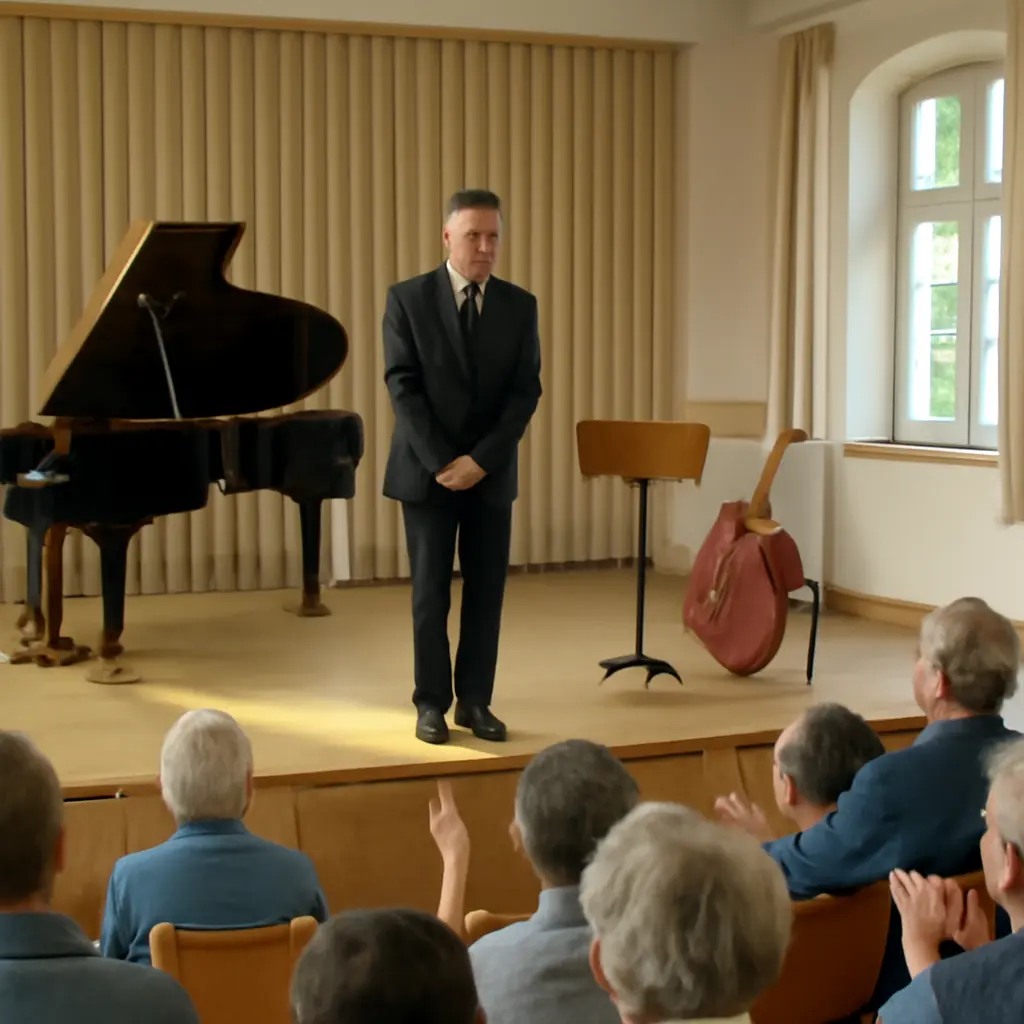
An entrance is the performer’s first direct communication with the room. Walking onstage at an unhurried pace, acknowledging the audience, and settling into position before adjusting equipment can signal that the performance has begun—even before the music does. The specific gesture should fit the setting: a brief nod may suit a recital, while a warm greeting may feel natural in a small club.
This is consistent with research on nonverbal communication in musical performance. The 2008 PNAS study by Chia-Jung Tsay and colleagues found that visual information alone could convey aspects of musicians’ expressive intentions. That result does not prove that one entrance style works for every audience, but it supports the practical point that listeners interpret what they see as part of the performance.
Posture, Eye Contact, and Readiness
Readiness is communicated through relaxed, purposeful posture and attention directed toward the ensemble or audience. Eye contact need not be constant; brief, genuine acknowledgment can establish connection without distracting from concentration. For soloists, a moment of stillness before playing can focus the room. For ensembles, shared attention—such as looking to the leader before a downbeat—helps communicate coordination and anticipation.
These choices also support practical performance goals. A deliberate pause gives musicians time to check that the room is quiet enough, confirm that players are ready, and take a coordinated breath. In this way, a social cue can double as a musical preparation.
Building Audience Connection Through Room Awareness
Room awareness is a performer’s ability to notice the audience, venue, and circumstances of a particular event and adjust communication accordingly. A quiet recital hall, an outdoor festival, and a noisy bar call for different approaches. Audience connection does not mean demanding attention; it means making the performance accessible within the conditions listeners are actually experiencing.
The National Endowment for the Arts’ 2022 Survey of Public Participation in the Arts reported that 48.3% of U.S. adults attended at least one live performing-arts event during the prior year, including performances such as music, theater, and dance. The finding highlights the substantial reach of live performance, while also reminding musicians that audiences bring varied expectations and levels of familiarity. A clear opening can help orient both devoted fans and first-time listeners.
Reading the Venue and Its Audience
Reading the room means noticing relevant conditions without making snap judgments about individuals. Performers can consider the room’s size, acoustics, audience arrangement, event formality, and whether people appear ready to listen or are still arriving. These observations help determine whether to begin promptly, offer a short welcome, or allow a few seconds for the space to settle.
A practical example is the difference between a seated chamber-music audience and festivalgoers moving between stages. The first may benefit from a quiet, unhurried opening; the second may need a concise verbal introduction that establishes the next set’s focus. In either case, awareness is more useful than a memorized routine applied identically everywhere.
Welcomes, Introductions, and Context
A welcome is a short spoken or nonverbal gesture that helps listeners understand the event and feel included. When speaking, musicians can give the audience a useful point of entry: the name of a piece, a brief story, or one detail to listen for. Context should clarify the experience rather than explain away the music. If the piece is self-explanatory or the setting favors uninterrupted listening, a simple acknowledgment may be enough.
This flexibility aligns with audience-engagement research. The Arts Council England report Evidence Review: The Role of Arts and Culture in Improving Health and Wellbeing describes participation and cultural experiences as varied rather than one-size-fits-all. Though it is not a performance-specific guide, it reinforces the value of considering people’s different ways of engaging instead of assuming every listener wants the same level of explanation.
Strengthening Audience Connection Through Shared Attention
Shared attention occurs when performers and listeners orient toward the same musical event. Before the first note, a coordinated breath, a visible cue from the leader, or a brief pause can help focus attention. These actions create a transition: conversation and movement recede, and the audience becomes ready to listen.
In a 2014 study in Frontiers in Psychology, Wolfgang Tschacher and colleagues examined live classical-music concerts and reported links between aspects of audience-performer movement synchrony and participants’ reported experience. The study does not establish that synchrony alone causes enjoyment, but it offers evidence that live music involves more than sound transmission: people’s bodily and attentional responses can become part of the event.
The Pause Before the First Note
A pre-performance pause is a brief, intentional moment of stillness before playing. It gives the performer room to breathe, listen to the space, and confirm readiness; it also gives listeners a clear signal that the music is about to start. The pause should feel purposeful, not theatrical. Its length depends on the repertoire and setting, and it may be only a breath long.
For ensembles, a shared breath or visual cue can synchronize the group and make the beginning feel unified. For a solo performer, stillness can communicate focus. Either way, the cue serves both artistic and practical functions: it helps musicians begin together and helps the room shift into attentive listening.
Authenticity Rather Than Performance of Connection
Authentic connection is communication that fits the performer’s personality and the music, rather than a set of gestures copied mechanically. Some musicians connect through warmth and conversation; others create intimacy through quiet concentration. Both can be effective when the behavior is consistent with the performance and respectful of the audience.
A useful test is whether a gesture helps listeners understand what is happening. If an introduction adds context, a pause gathers attention, or a glance reassures an ensemble, it has a clear purpose. If a gesture distracts from the music or feels unlike the performer, simplifying it may create a stronger connection.
Applying Audience Connection Before a Performance
A repeatable preparation routine can help musicians build connection while remaining adaptable. The routine need not be elaborate; it should make the transition into performance calm, clear, and responsive to the venue.
- Observe the space and note practical conditions such as acoustics, audience placement, and background noise.
- Choose an entrance and greeting that fit the event’s formality and the performer’s natural style.
- Settle equipment and instruments before asking the audience to focus, where circumstances allow.
- Decide whether listeners need a brief introduction or whether the music should begin without explanation.
- Take a breath, confirm ensemble readiness, and use a clear cue to begin.
After the performance, musicians can reflect on observable outcomes rather than guessing what every listener felt. Did the room become quiet? Was the opening cue clear? Did the introduction help orient people? Notes from collaborators, presenters, or audience feedback can inform the next performance. This turns connection into a learnable practice rather than a matter of charisma alone.
Conclusion: Audience Connection Begins Before the Music
Pre-performance presence, room awareness, and shared attention all contribute to audience connection before the first note. Research on visual musical cues and live concert interaction supports the idea that listeners respond to more than sound, while participation data underscores the broad importance of live arts experiences. A composed entrance, an appropriate welcome, and a purposeful pause can help audiences feel oriented and invited.
Musicians can start by choosing one simple pre-performance cue to practice, then adapt it to each venue and audience. The aim is not to manufacture intimacy, but to make attention, readiness, and respect visible. When that foundation is in place, the first note arrives not as an isolated sound, but as the beginning of a shared experience.
Sources: Tsay, Chia-Jung, et al., “The Influence of Visual and Auditory Information on Perception of Musical Performance,” Proceedings of the National Academy of Sciences, 2008, https://www.pnas.org/doi/10.1073/pnas.0800444105; National Endowment for the Arts, “2022 Survey of Public Participation in the Arts,” https://www.arts.gov/impact/research/arts-data-profile-series/adp-32; Arts Council England, “Evidence Review: The Role of Arts and Culture in Improving Health and Wellbeing,” 2014, https://www.artscouncil.org.uk/publication/evidence-review-role-arts-and-culture-improving-health-and-wellbeing; Tschacher, Wolfgang, et al., “Synchrony between Audience and Performer in Live Concerts,” Frontiers in Psychology, 2014, https://www.frontiersin.org/journals/psychology/articles/10.3389/fpsyg.2014.00939/full.